Raise Your Voice, Find Your People: America’s Community Choir Moment
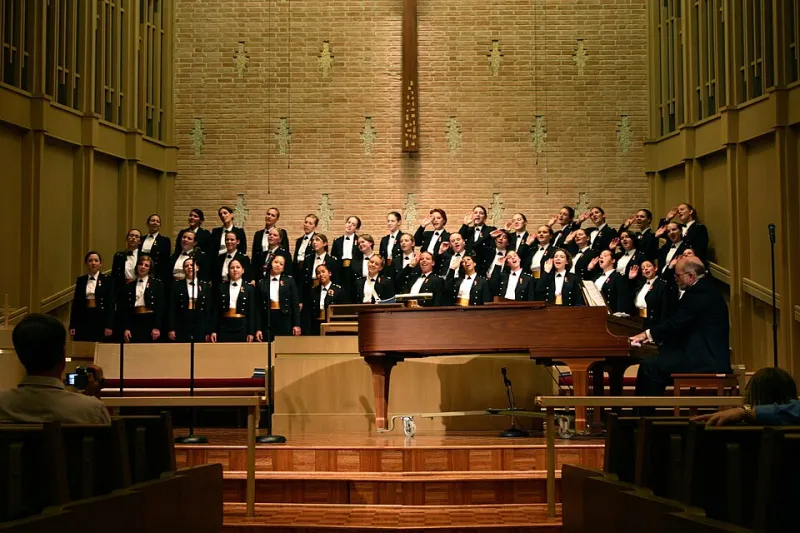
Photo: U.S. Navy photo by Journalist 1st Class Bill Kerstetter, Public domain, via Wikimedia Commons
On a rainy Monday in November 2026, the basement of a communications workers’ hall in Detroit smells like coffee and wet wool. About 70 people are standing in a loose semicircle, coats piled on folding chairs, working through the chorus of 'Ain’t No Mountain High Enough.' Nobody is auditioning. Nobody is wearing matching robes. A woman in scrubs next to a retiree in a Pistons cap is harmonizing without looking at sheet music. This is the Motor City Singers, and it is one of a growing number of community choirs across the U.S. that have turned group singing into a social lifeline.
The numbers are fuzzy because no one tracks unaffiliated choirs, but organizers, librarians, and arts councils describe a clear shift. Since 2023, no-audition choruses have multiplied in churches, breweries, libraries, and union halls. The pandemic interrupted communal singing; the aftermath made people hungry for it. In 2026, the choir has become the new club — less expensive than a gym, less awkward than a networking event, and louder than a book group.
The Monday-Night Convert
Renee Alvarez, 41, started Motor City Singers in 2022 after a stretch of remote work left her talking mostly to her dog. She is a hospital scheduler with no formal music training. 'I wanted a place where people could sing badly and still come back,' she says. The choir now draws 120 members across two weekly rehearsals. Repertoire leans on Motown, gospel, and pop. Dues are pay-what-you-can. No one is turned away.
Alvarez’s model is deliberately low-friction. No auditions. No mandatory performances. Music is taught by ear and with lyric sheets. 'We spend the first 20 minutes learning names and breathing,' she says. 'That’s not a warm-up. That’s the point.' Members range from a 19-year-old community college student to a 78-year-old retired bus driver. They sing at a senior center twice a year and, mostly, for each other.
Three Cities, One Refrain
The boom is not a single sound. In Tucson, Benji Ortiz runs Desert Harmony, a sober-friendly chorus that meets in a community center with reliable air conditioning. In Asheville, Maggie Chen organizes the Blue Ridge Belters, a come-as-you-are group that rehearses in a brewery back room. Different cities, different repertoires, same hunger.
Detroit: Motown in a Union Hall
Motor City Singers is intentionally unpolished. Alvarez chooses songs people already know from the radio, then breaks them into simple parts. The result is not a concert choir; it is a room full of people remembering how to make something together. 'We have nurses, electricians, a guy who does HVAC,' Alvarez says. 'They don’t need another place to be judged. They need a place to be loud.'
Tucson: A Chorus for the Quiet Ones
Ortiz, 32, is a school counselor who started Desert Harmony in 2024 after noticing how many adults in his life had no regular social outlet. The chorus is small — about 35 regulars — and explicitly welcoming to people who find bars and dating apps exhausting. 'We call it a choir, but it’s really a weekly appointment with other humans,' he says. They sing folk songs, pop standards, and the occasional Disney number. No one has to explain why they are there.
Asheville: Harmony After Hard Times
Chen, 47, is a landscape designer who began the Blue Ridge Belters after the 2024 hurricane season left her neighborhood raw. The group meets in a brewery that stayed open through the recovery. Rehearsals are short, social, and sometimes end with everyone crying in the parking lot. 'We aren’t therapists,' Chen says. 'But singing next to somebody does something that a group text can’t.'
How to Find Your Choir (Without Overthinking It)
You do not need a trained voice. You do need a search strategy. Start with the terms 'community choir near me 2026,' '[your city] no-audition chorus,' and '[your city] pop-up singing.' Check library bulletin boards, local arts councils, community centers, Unitarian churches, Meetup, and neighborhood Facebook groups. Ask a music teacher at a community college; they often know the informal groups that never advertise.
When you find a candidate, ask four questions: Do you audition? What are the dues? How often do you rehearse, and is attendance mandatory? Is the space accessible, and is the group alcohol-free? None of these questions are rude. A good choir will have answers.
What to Expect at Your First Rehearsal
Bring water and a pencil. Arrive ten minutes early. You will probably do a physical warm-up, a vocal warm-up, and then learn one song in sections. No one will ask you to sing alone. Sit near someone who looks confident. If you lose your place, stop and listen; that is allowed. You will not leave knowing the whole song, and you will not be the only new person.
The bigger surprise is the room itself. Community choirs are not made of people with perfect pitch. They are made of people who decided to show up. In 2026, that may be the most useful skill in America.