Stop Scrolling, Start Developing: The Small-City Darkrooms Bringing Film Back Into Focus
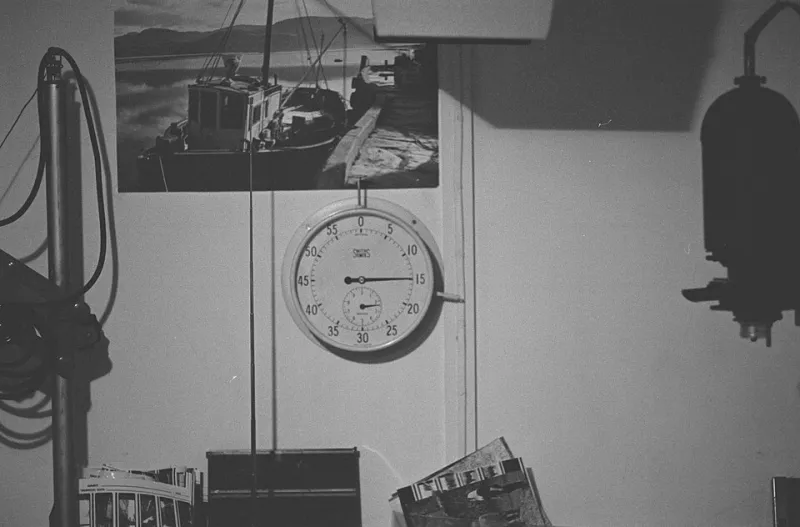
Photo: Geoff Charles, CC BY-SA 4.0, via Wikimedia Commons
On a Thursday in November, the basement of First Covenant Church in Grand Rapids, Michigan, smells like vinegar and possibility. Nine people are arranged around three enlargers, and nobody is looking at a phone. A retired machinist named Gus is teaching a 19-year-old nursing student how to dodge a shadow out of a portrait of her grandmother. The timer buzzes. Somebody says “again” and means it kindly.
This is not a nostalgia tour. It is a Tuesday-night rhythm that has quietly become one of the more interesting things happening in American cultural life in 2026: the analog photo club, rebuilt from the ground up in converted storefronts, church annexes, and the back rooms of camera shops.
Why grain feels like relief
The easy explanation is that film is a reaction to AI-generated imagery. There is something to that. When a convincing photograph can be conjured from a sentence, a negative starts to feel like a receipt — evidence that a person stood somewhere, waited for light, and got it wrong twice before getting it right.
But the organizers I spoke with push past the tech-angle. They talk about attention, and about the particular social contract of a darkroom: you cannot scroll while your hands are in chemistry. You cannot multitask in the dark. The room enforces a kind of presence that people seem to be paying for on purpose.
“We get a lot of people who work on screens all day,” says Marisol Vega, who runs a club in Dayton, Ohio. “They don’t come here to be good at photography. They come here to be unavailable for two hours.”
Three rooms, three ways of doing it
Dayton: the storefront model
Vega spent fifteen years as a wedding photographer before opening The Daylight Project on Wayne Avenue in 2023. The space was a check-cashing store; now it holds a film-loading bench, a small gallery wall, and a rental darkroom that members book in three-hour blocks. Membership runs $45 a month on a sliding scale, and there is a waiting list.
What makes it work is the calendar. Mondays are open lab. Wednesdays are a beginner cohort. One Saturday a month is a “contact sheet hour,” where everyone pins up unedited proof sheets and takes questions. Vega is strict about one thing: no critiques of the person, only the frame.
Chattanooga: the church-basement model
Pastor Dale Whitcomb did not set out to run a photo club. He set out to use a basement that sat empty six days a week. A parishioner donated two enlargers; a local estate yielded a third. Common Ground Darkroom now opens Tuesdays and Saturdays, free with a suggested donation, and its membership skews from 14 to 84.
The club’s secret weapon is a retired chemistry teacher who mixes the developer and a group of teenagers who shoot on inherited cameras. Whitcomb says the mix is the point. “You get a kid and an elder arguing about contrast, and neither one is being condescending. That’s not nothing in 2026.”
Tacoma: the former dry cleaner
Sixth Avenue Silver occupies a building that still has the ghost of a dry-cleaning counter. Tanya Brooks and two partners took it over and kept the tile floor, which is good for spills. They run paid intro workshops, a women’s darkroom night, and a repair table where broken cameras get triaged.
Brooks is blunt about the economics. Chemistry is expensive. Ventilation is expensive. Enlargers are cheap to buy and costly to move. The club survives on memberships, workshops, and a small print sale each December. “Nobody is getting rich,” she says. “We’re getting a room.”
The unglamorous mechanics
A typical club night is less romantic than the word “darkroom” suggests. Someone is always hunting for a missing negative carrier. The fixer needs changing. A beginner has loaded film onto a reel backward and must be talked through it without shame. The prints are often bad, which is the deal you make.
What surprises newcomers is how much of the craft is social. You learn to read a test strip by watching someone else’s. You learn to spot a light leak because a stranger points at the edge of your frame. The skills travel person to person, not through a tutorial.
If you want in: a starter guide
- Start with a local camera store, not a search engine. Small shops often know which clubs have open lab hours. Community colleges and arts councils are the next best leads.
- Ask for an intro session. Most clubs offer a one-night orientation before you commit. Take it before you buy anything.
- Borrow before you buy. A working 35mm camera and one roll of film will teach you more than a closet of gear. Ask the club what film they recommend for their chemistry.
- Budget for the boring stuff. Expect $30 to $60 a month for membership in a city, plus film and printing paper. Many clubs have sliding scales; ask.
- Learn the etiquette. Rinse your trays. Label your chemistry. Don’t open the door when the red light is on. Those rules are the whole culture.
- Give it three sessions. The first night is confusion. The second is competence. The third is when it gets fun.
The point is not the photograph
The photographs matter, obviously. Some of the work coming out of these rooms is genuinely good — quiet portraits, neighborhood streetscapes, the sort of images that require a person to stand still and wait.
But the reason these clubs are filling up in 2026 is simpler than a revival narrative. They offer a place to be a beginner in public, with other beginners, in a culture that mostly rewards being finished. That is a rare thing to find on a Thursday night. The red light is on. Come in.